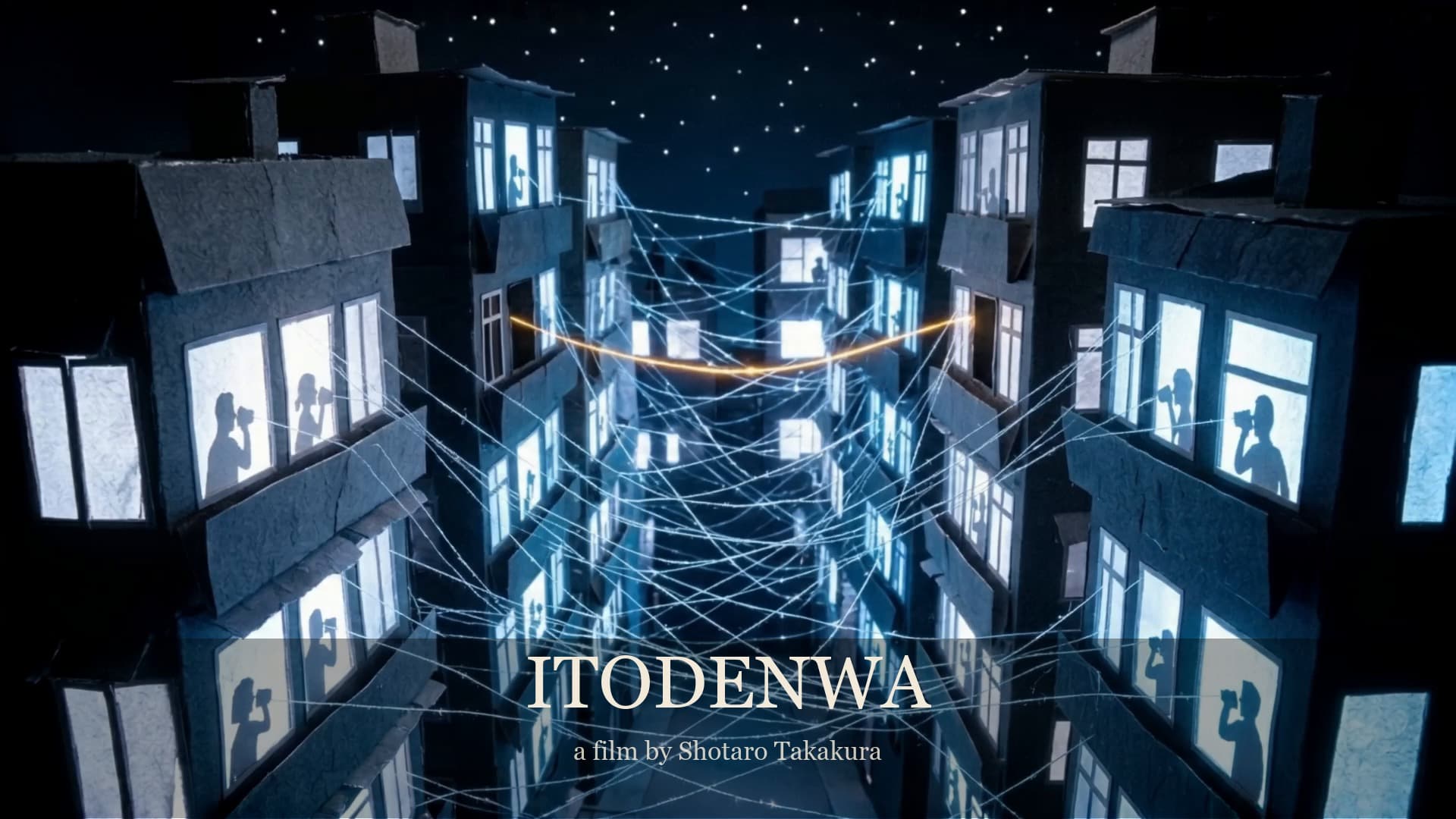
Itodenwa
by Shotaro Takakura
Synopsis
In a city made of folded paper, every window is tied to every other by glowing strings. Messages race along them as sparks of light, and paper cups chime day and night. Everyone is talking; no one is facing anyone. A boy cannot sleep. Dozens of strings end at his wall, and when he presses a cup to his ear he hears only murmur — the strings hang slack and tangled, carrying everything and delivering nothing. One night he picks up a pair of scissors and cuts them, one by one, then all at once. For the first time, silence. His window becomes the single dark spot in the city of light. In that dark he notices what the glare had hidden: stars above the web of strings, and, across the street, another unlit window that has been dark all along. An old woman sits behind it. They raise a hand to each other. The boy ties one string to one cup and throws it across the street. It falls short. He throws again; it slides down her wall. She disappears — and returns with an umbrella, hooks the string with its handle, and ties it to a dusty tin can she has kept for years. The string still sags. She takes one step back. He takes one step back. The string pulls tight, and a string telephone only works when it is tight. He speaks; a single warm light crosses the street; and out of his paper cup comes the only human voice in the film — her laugh. Seen from above, the city glitters with ten thousand connections. Between two dark windows, one string is quietly alive. Itodenwa (Japanese for "string telephone") is a wordless paper-cutout short about the difference between being connected and reaching someone: connection needs tension — distance, effort, and one person on the other end.
Project members
- Writer, director and editorShotaro Takakura
Discover more films




Become a partner of the festival!
mk2agency@mk2.com